

Smarter, Adaptive and Scalable Solutions
The value of combining stretchable electronics with Artificial Intelligence (AI) lies in the benefits that emerge when physical adaptability meets intelligent data processing.
Converting Sensor Data into Meaningful Action
Printed stretchable sensors conform to surfaces instead of reshaping them, and thus they become a natural part of the environment. This improves durability, enhances user comfort, and enables applications that would be impractical or too costly with traditional rigid sensors.
Stretchable sensors combined with machine learning and AI extend sensing beyond simple measurement. In addition to raw data streams and force curves, the stretchable solution with AI detects events, motion patterns, behavioural changes, or early signs of wear and failure. These functionalities are much needed for example in automotive human-machine interfaces, in-car seat occupancy solutions and future humanoid robotics that benefit from sensors which adapt to the movement of a user or a robot. AI combined with stretchable sensors allows systems to learn, adapt, and maintain performance over time in changing conditions – mastering surface curvature, installation differences, temperature, and aging. These solutions convert large volumes of data into relevant information and ultimately into concrete actions or system functionality.

Edge Intelligence close to the Hardware
One of the great benefits of combining stretchable sensors with AI is that intelligence can be placed close to the sensor, enabling data processing directly at the source via edge computing rather than processing it in a cloud and utilising data centres further away. This significantly improves efficiency and scalability. By processing data at the edge, systems reduce bandwidth requirements, lower power consumption, and decrease latency. This is especially important in distributed sensing environments, where large sensor networks must operate reliably and responsively. Lightweight machine learning models can interpret sensor outputs early in the signal chain, enabling real-time action.
The Path Toward Intelligent Physical AI Systems
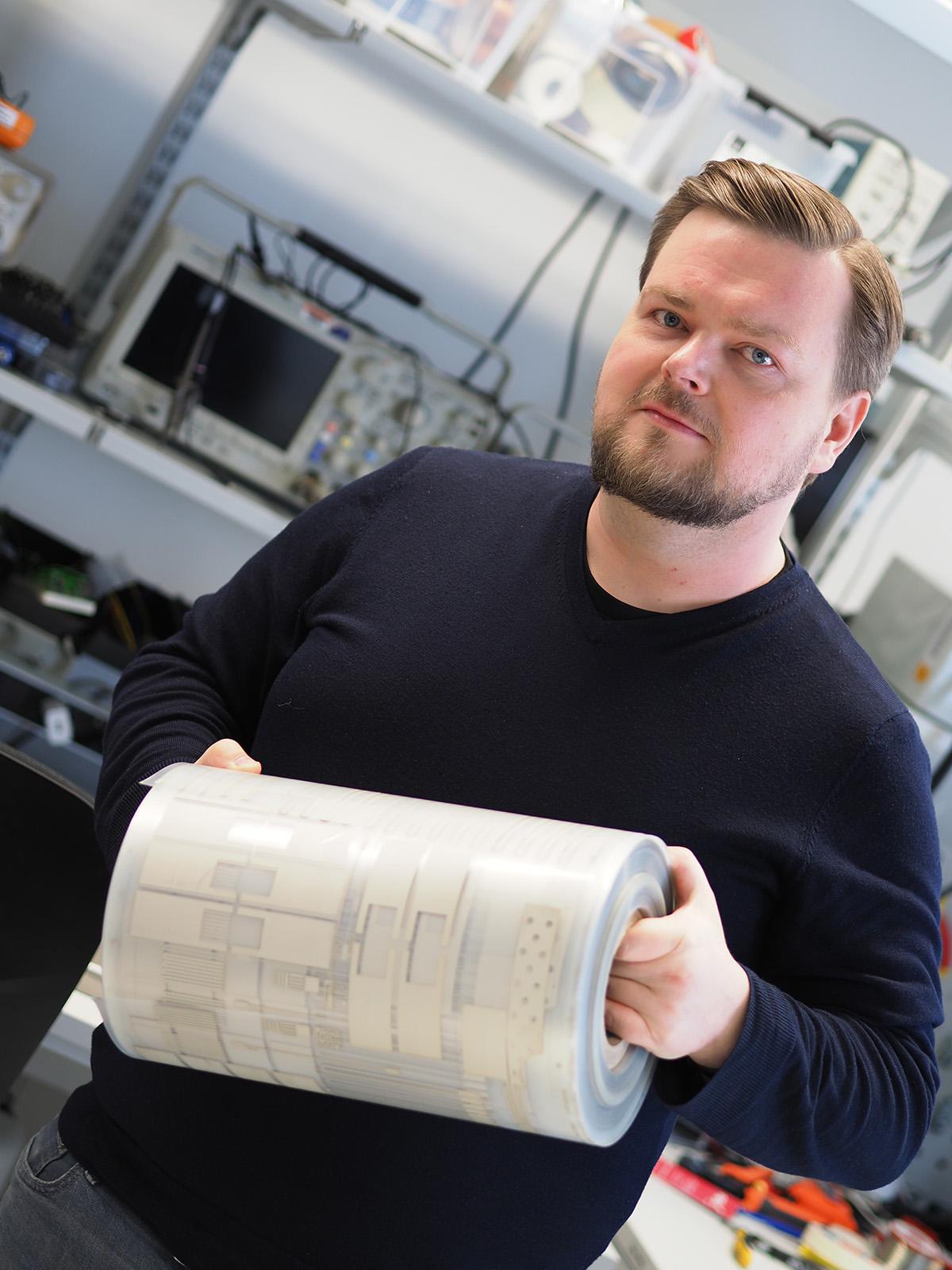
The integration of stretchable printed electronics and artificial intelligence begins with a clear division of roles. Printed sensors form the physical interface with the real world, while AI interprets their signals.
Stretchable printed electronics are designed to mechanically adapt to their environment. Unlike rigid components, they can be embedded directly into real structures such as wearables, seats, machinery, or infrastructure. Manufactured through scalable printing techniques, these sensors can be produced cost-effectively in large volumes while maintaining design flexibility. Their geometries and layouts can be tailored to specific applications, enabling sensing across different sizes of surfaces.
The integration of stretchable printed electronics and AI represents a shift in how sensing systems are designed. These Physical AI systems begin to move, sense, and respond in a coordinated way, resembling the responsiveness of living systems rather than static devices. They can evolve alongside their environment and users, delivering long-term value through continuous adaptation and learning.
In this way, the combination of adaptive hardware and intelligent software is not just an incremental improvement—it is a foundation for a new generation of sensing systems that are adaptive based on need, cost-efficient, and seamlessly integrated into the world around them.
Toni Liimatta
Solution Architect, Forciot Oy